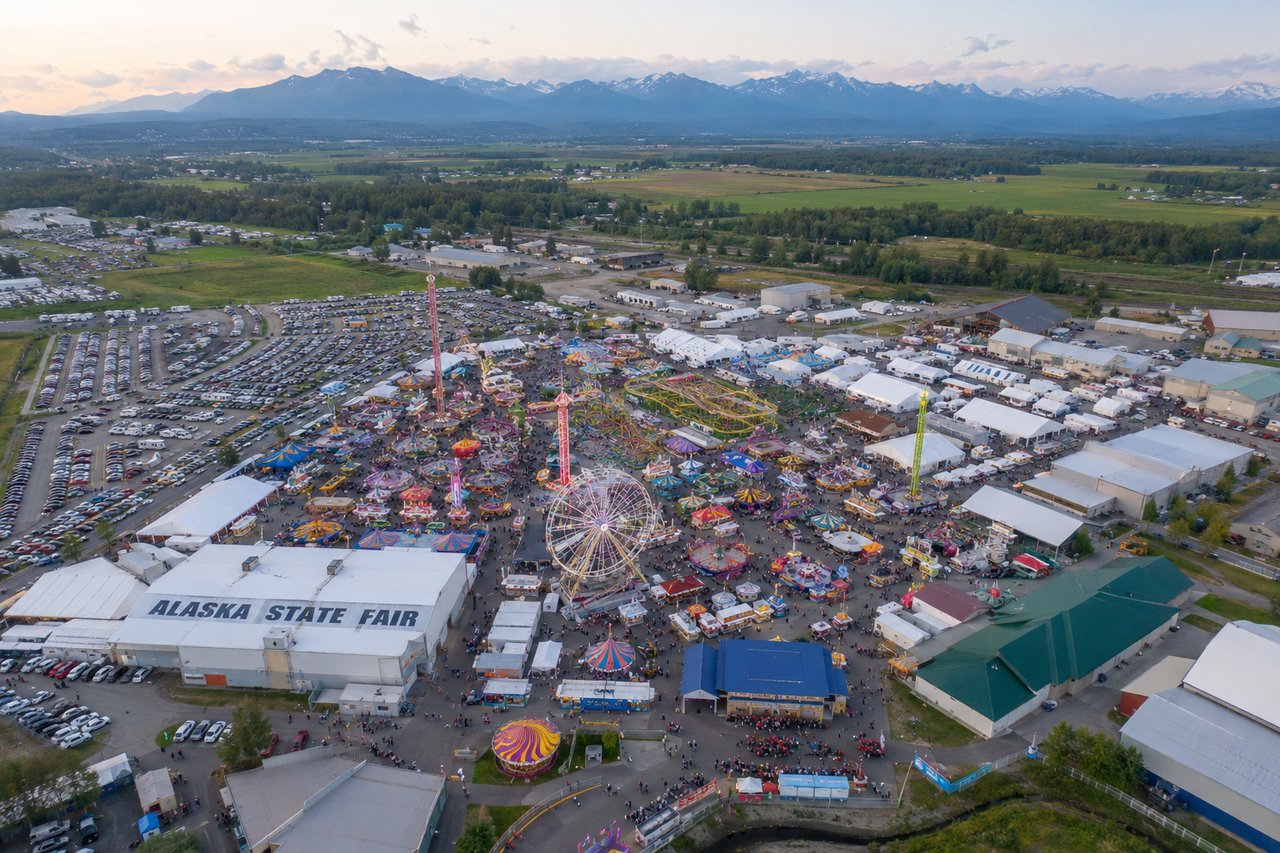
Every year around this time, downtown Palmer fills up. The Alaska State Fair runs through September 7, and for two and a half weeks the fairgrounds pull in more people than the rest of the Matanuska-Susitna Valley sees most months. Funnel cake, livestock judging, the midway lights against an early-dark sky. It is the version of Palmer that gets photographed.
A few miles out, on farms most fairgoers drive past without noticing, a different harvest is running on its own clock. It started before the fair opened and it will end before the fair's last day feels like a memory. Nobody sells tickets to it. That is exactly why the people who live here treat it as the real event.
Two calendars, not one
The fair has a fixed run: August 21 to September 7. The harvest does not care about that schedule. Potatoes in this part of the valley hit their picking window in late August and September specifically because the soil stays cool longer here than in warmer growing regions, which is also why Matanuska Valley potatoes have a reputation for flavor that faster, warmer soil doesn't produce. That timing has nothing to do with when the fair's gates open or close. It is soil temperature, not a calendar printed by an events committee.
That mismatch matters if you are the kind of resident who assumes "harvest season" and "fair season" are the same two and a half weeks. They overlap, but they are not identical, and the farms around Palmer are running their own version of the fall that started earlier and will outlast the fairgrounds by days or weeks depending on frost.
Pyrah's runs on its own season entirely
Pyrah's Pioneer Peak Farm, out on South Bodenburg Loop, is the biggest single reason to know the difference. At 277 acres, it is the largest U-Pick vegetable operation in the state, a working farm that traces back to 1935 as part of the original homesteading project that put families on this stretch of the valley in the first place. More than thirty vegetable varieties come through the fields there across a season, and the U-Pick opening date shifts year to year based on weather and crop readiness rather than a fixed date on a poster.
What Pyrah's does that the fairgrounds don't is hold its own Fall Harvest Festival every September, with pumpkin picking, wagon rides, and a petting zoo built around the tail end of the growing season rather than around tourism traffic. It is not a satellite event of the fair. It runs on its own weekend, announced on the farm's own site closer to the date, because the farm decides when the crops say it is ready, not when the Division of Agriculture's calendar says fall has started.
Here is roughly how the pieces line up this time of year:
| Where | What's happening now | The catch |
|---|---|---|
| Pyrah's Pioneer Peak Farm | U-Pick vegetables, Fall Harvest Festival in September | Opening and festival dates shift with the crop, not with the fair |
| The Apple Patch | Apple and raspberry U-Pick | By appointment only, no walk-ins |
| Bushes Bunches Produce Stand | Fresh produce, no field walk required | Stand-only, not a U-Pick experience |
| Bodenburg Butte cluster (VanderWeele Farm, Arctic Organics, Rempel Family Organics) | Organic vegetables at scale | Rempel alone grows over 100 varieties on 135 certified organic acres |
The Bodenburg Butte cluster works differently than Pyrah's
Head toward Bodenburg Butte and the farm character changes. VanderWeele Farm, Arctic Organics, and Rempel Family Organics sit clustered in that stretch of the valley, and Rempel alone farms more than 100 different certified organic vegetable varieties across 135 acres. This is not a U-Pick tourist stop built around a festival weekend. It is working agricultural land that happens to be close enough to downtown Palmer that residents treat a drive out there as a normal Tuesday errand rather than a special occasion.
The Musk Ox Farm sits just north of downtown Palmer too, close enough to fold into the same afternoon. It is not a harvest stop in the vegetable sense. It is a nonprofit built around qiviut production, the fiber combed from musk oxen rather than sheared, and it gives the same drive a reason to include a stop that has nothing to do with produce at all.
The Apple Patch skips the whole model
Not every U-Pick operation near Palmer works the way Pyrah's does. The Apple Patch, also in Palmer, grows apples and raspberries and sells apple trees, but there is no showing up whenever you feel like it. Picking happens by appointment only. That is a real friction point for anyone used to Pyrah's drop-in model, and it is the kind of detail that only shows up if you have actually tried to plan a visit rather than just read a farm's name off a list.
If the field isn't the point
Some residents want the produce without the walk through the rows. Bushes Bunches Produce Stand, just outside Palmer, has supplied fresh local produce to Palmer, Wasilla, and Anchorage since 1954. It operates as a stand, not a U-Pick field, which makes it the option for anyone who wants Matanuska Valley produce on a Tuesday afternoon without carving out the hour a real U-Pick trip requires.
The window closes faster than Labor Day weekend suggests
Alaska Farm Tours, which runs guided circuits out of the Palmer Museum and Visitors Center to three working farms plus a local farm stand, operates its 2026 season from June 15 through September 15. That is a fixed outside date, and as of today it leaves a little over two weeks before that particular door closes for the year. The U-Pick fields themselves do not run on a printed end date the way the tour does. They run until frost or until the crop is picked out, whichever comes first, and in a growing season this short, that point tends to arrive earlier than people expect.
That is the piece easy to miss if your mental model of "Palmer in the fall" starts and ends at the fairgrounds. The fair has an advertised close of September 7. The farms around it are working against a colder, less predictable deadline that has nothing to do with ticket sales, and most of them will be done long before anyone stops talking about the fair.
The version of fall that actually belongs to Palmer
The fair is the loud version of this season, and it earns the attention it gets. But the quieter version, the one running in the fields along Bodenburg Loop and out toward the Butte, is the one that actually defines what late August and September mean here. It is short, it runs on soil temperature instead of a schedule, and most of it will be over before the leaves finish turning.
If you already know these fields, none of this is new. If you have lived in Palmer for a season or two and never made it past the fairgrounds gate, the actual harvest is happening a few minutes away right now, and it will not wait for the fair to end to finish its own season.
Palmer's appeal has always been this layering: a small town built on agriculture that still runs its farms the way it always has, sitting a short drive from Alaska's largest city. If a place with two working seasons, one loud and one quiet, sounds like where you want to put down roots, Top Homes Alaska knows this valley block by block, harvest and all. Schedule Your Personal Consultation when you're ready to talk about what living here actually looks like, twelve months a year.